Showing posts with label Poison Fiction. Show all posts

Tuesday, March 8, 2022

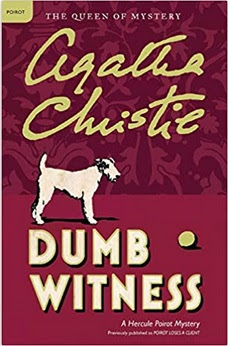
Review: Dumb Witness by Agatha Christie


"I really could not say who you suspect, Hastings! Everybody in turn, I should imagine!"


Arthur Hastings isn't the only one who veers from one suspect to another as the story unfolds.  The possible criminal is surely this person, oh, wait! No, it's that person.

I was convinced I knew the killer all along.  Not even close.

Poirot receives a letter from Miss Emily Arundell asking for his help.  She's very vague in her suspicions, and there are many words crossed out.  Even so, Poirot is interested in the case.

To his chagrin, he finds that the letter he just received was written a couple of months ago, while the writer of it was still alive.

Determined to see if there was foul play, he talks with everyone involved in her last days.  It appears she died of liver disease, which she'd had for a long time.

The family are already angry that they were left out of Emily's will and all was left to her companion.  To have Poirot suspect murder, and he rapidly does, shocks and disturbs them even further.

The motive, says Poirot is gain. Just about everyone thought they'd gain a hefty inheritance when Emily died.  Did someone help her along?

Memorable characters, deft plotting, and a charming dog are all that's needed for another enjoyable mystery.

Tuesday, January 18, 2022

Review: The Lost Apothecary by Sarah Penner


Nella is an apothecary in 1791 London. Long ago, she took over her mother's apothecary business.  

While her mother was purely a healer, Nella's own path has led her to be a dispenser of poisons. She sells these only to women who are in dire need.  Her shop is well hidden in a back alley.  Where the front of her mother's shop used to be, there's only an empty room with a grain barrel in which the desperate place a letter asking for help.

Each customer is entered in her register, name, prescription and amount, and who the medicine is for.  Nella feels she is preserving the lives of the women who come to her who would otherwise be nameless in history.

One day she receives a curious note in tidy hand requesting her services.  Something about the note causes her to worry and be cautious. 

The next day, twelve year old Eliza, a household servant, comes to collect the poison.  She admits she wrote the note and is getting the medicine for her mistress and herself.  Completely self-possessed, she answers Nella's questions and listens to her instructions for administering the poison, which she will do herself.

From Eliza's chapters, we learn the truth of her situation, and how though the poison was successful, things fall apart at the manor with the demise of the master of the house.  Left on her own while the mistress retires to a country estate, Eliza goes to Nella's and asks to stay there and learn something of the apothecary business while her mistress is away.

Nella, horrified, sees what the dispensing of poisons has done to her own body and soul, and refuses.  Though she tries to push Eliza away, the child becomes involved with Nella's next customer, to the ruination of all of them.

In the present day, Caroline is on vacation alone in London unexpectedly. She was to celebrate her tenth anniversary with her husband on this trip.  Learning that he's been having an affair with a co-worker shatters all she was hoping for and she comes to London alone and to sort things out.

On a mudlarking expedition with a chance group of people, she finds an apothecary jar in the mud with an etching of a bear on it.  Trying to re-connect with the student of history she once was, and keep her mind busy, she researches the jar and tries to find its history with the help of a new friend at the British Library.

Through Caroline's research we find out what happened to Nella and Eliza in the past. Her own story echoes that of many of the women in the apothecary's register.

I loved the parts of the story in old London. Nella and Eliza are so wonderful together despite Nella's reluctance to let Eliza into her life.

Things are messier in the present day, and while I wished Caroline well, I was ready to hear more about Nella and Eliza.


https://www.sarahpenner.com/
Tuesday, November 2, 2021

Death In The Clouds by Agatha Christie


On a routine flight from Paris to Croyden, England, there is a small disturbance of a wasp flying about.  As passengers prepare to land and are given their bills for in flight services, one lady is unresponsive.

It turns out she is dead.  Examined by a doctor on board, who is accompanied by a curious Poirot, they notice a mark on her neck. Poirot, bending down, finds what appears to be a small, oddly painted dart.

It is declared a murder has taken place, and all passengers are detained and questioned.  

At an inquest later it is determined that Madame Giselle, a Parisian moneylender, was killed by a poisoned dart, which was expelled via a blow pipe used by certain South American tribes, by an unknown person, though the jury wanted to charge Poirot!


In the passenger plan above, you see the victim was in seat number two.  Very few passengers had a line of sight to shoot anything at her.  No one saw anyone else doing anything so suspicious as blowing a dart at another passenger.  Few people even got up from their seats during the trip.  

Poirot and his old colleague Inspector Japp interview passengers and others of interest in England and Paris.

There's a chapter called the List which I enjoyed that showed what each passenger had in their possession.  Many of the passengers had some sort of reading material with them, from books to magazines.

One of the most interesting passengers was a mystery novelist who drew some suspicion to himself with his knowledge of blow pipes and various methods of murder.

Poirot takes a young couple under his wing and enlists their help in his investigation.

One of my favorites so far.


Tuesday, September 28, 2021

Three Act Tragedy by Agatha Christie


 Hercule Poirot appears very little in this novel, and that is mostly near the end of the story.  In spite of this, Three Act Tragedy is a highly entertaining mystery.

Thirteen are gathered for dinner (plus one) at the home of famous actor Sir Charles Cartwright.  We learn all about the various attendees from an omniscient narrator and somewhat from the observations of Mr. Satterthwaite, a fellow who is a patron of the arts and who considers himself a keen observer of human nature.

Practically before the dinner party has a chance to  get started, one of the guests, a clergyman, suddenly seems to choke on his cocktail, and in moments he's dead.

A doctor on the scene, Bartholomew Strange, pronounces Stephen Babbington dead.  Babbington had a few health problems, so it is assumed one of those took the elderly man at this misopportune moment.

Charles Cartwright, however thinks something more happened, and he discusses this theory with his friends Satterthwaite and Strange.  He also mentions his theory to young Hermione "Egg" Lytton Gore, who has a bit of hero worship for the older Charles.

A few months later, there's another dinner party, with many of the same attendees, sans Poirot.  Another death immediately after a drink is taken.

Now the game is on, with Satterthwaite, Cartwright and Egg consulting and crisscrossing the countryside to try to find out who the murderer is, for they're all certain now there were two murders.

The first murder, of the innocent seeming clergyman must hold the key.  What could be the motive, and why was there no trace of poison in the glasses used by either victim?

I wondered at the point of view and the leaving Poirot out of the hunt for the killer for much of the story.  The would be detectives have a thrilling time out asking questions of witnesses.  Was this to give the reader a viewpoint wherein they knew what the detectives knew, and they could solve the murder right along side them? Poirot himself famously holds much information back.

I, for once, actually suspected the killer, but not their motive or method.  I was a bit proud of myself.

Three Act Tragedy was formerly published as Murder In Three Acts which is a better title, all in all, I think.